

We are a global management consultancy that delivers exceptional outcomes and sustainable change

We are a global management consultancy that delivers exceptional outcomes and sustainable change

Article

Identifying USD 25mil in Hidden Value: How Operational Diagnostics Transformed a Global Energy Company

July 30, 2026 | Operational Analysis
Related Services
Related Industry
Share This Article

Following an operational diagnosis conducted by YCP Renoir for a global integrated energy company across its onshore and offshore environments, we discovered a production deferment reduction of USD 25 mil in Year 1. This estimate excludes backlog reduction and wrench-time monetization because additional maintenance work-hour values have not yet been quantified. Once implementation baselines and targets are validated, the total financial opportunity is expected to exceed USD 25 mil.

Unstable Operating Model Leading to Productivity Losses

In asset-intensive energy operations, productivity losses are not always caused by a lack of effort, commitment, or technical capability. More often, performance is lost when the operating model around the workforce is unstable.YCP Renoir’s client, a global integrated energy company, experienced significant productivity losses despite maintaining formal processes, established planning routines, maintenance systems, performance reviews, and experienced leadership. These losses were due to:

  • Frequent break-ins
  • Increasing maintenance pressure
  • Low wrench time
  • Operational disruptions
  • Planning instability
  • Production deferment

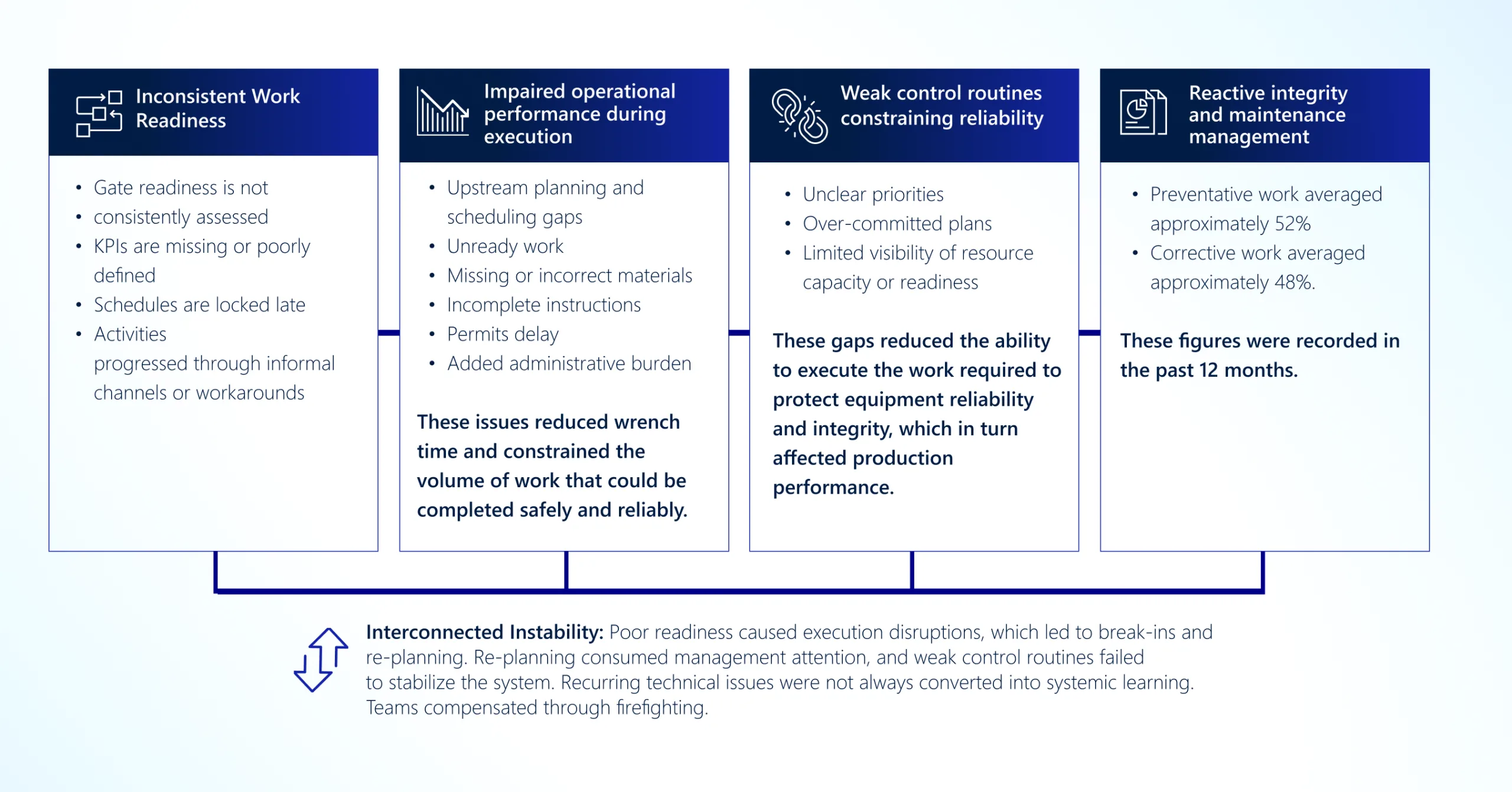
These issues cascaded to affect reliability, asset integrity, and operational performance. Much of the performance loss originated upstream, before technical teams arrived at job sites. Upstream gaps in planning, scheduling, material readiness, permitting, work package quality, contractor alignment, and decision-making predetermined the outcomes of execution before hands-on work began.

What YCP Renoir Did: Changes to Improve Reliability, Integrity, and Operational Performance

“How do the organization’s systems, processes, behaviors, and performance outcomes interact across onshore and offshore operations? What must change to improve reliability, protect asset integrity, stabilize execution performance, and unlock sustainable productivity?”

YCP Renoir conducted a four-week diagnostic evaluation to assess the organization’s processes, systems, data, and behavior. The evaluation was based on field studies, leadership interviews, meeting observations, operational data reviews, and an Organizational Behavior Survey (OBS). The evaluation focused on:
Evidence Base Outcomes
1. Root Cause Analysis (RCA) Identified root causes of planning instability, operational disruptions, break-ins, production deferment, and escalating maintenance backlogs. Finding: upstream disruptions stemmed from weak readiness, late scope, unclear priorities, and cross-functional misalignment before execution.
2. Planning and Work-Management Framework Assessment Tested whether the integrated framework consistently created executable work. Finding: framework existed but readiness discipline varied across functions. Work validation, gatekeeping, planning, and feedback were inconsistently applied, allowing work to progress without sufficient readiness.
3. Management Control System (MCS) Assessed whether the MCS steered performance. Finding: forums gathered information rather than drove performance. Feedback loops, escalation, and decision clarity were insufficient to stabilize execution.
4. Operational Improvement Potential Quantified improvement opportunities. Finding: measurable opportunities identified in wrench time, materials readiness, execution efficiency, backlog reduction, break-ins, and production deferment elimination.
5. Organizational Behaviour and Operating System Examined how the operating system shaped behavior. Finding: firefighting became normalized because the system did not consistently reinforce readiness, accountability, and stable execution. 

What YCP Renoir Found: Systemic Instability Before Execution

The diagnostic concluded that the fundamental problem was not a missing process. It was the absence of a fully aligned, stable, and integrated operating model.

This instability showed up in four connected ways.
What YCP Renoir Implemented: Connecting Symptoms to Value

The diagnosis began at the point of execution and worked backward through the organization.
1. Leadership interviews identified how leaders perceived performance challenges, establishing hypotheses for testing.
2. Work-management workflow review examined the planning and work-management framework from work notification through closure.
3. Readiness assessment identified gaps in functional-plan integration, toll-gate criteria, long-term to medium-term planning alignment, two-week plan integration, and operating discipline.
4. RCA reviewed over 400 recorded events, with approximately 200 requiring RCA.
5. Demand analysis examined backlog, inspection backlog, break-ins, and maintenance campaigns to understand how work demand destabilized the system.
6. Cross-functional assessment broadened to include Drilling and Wells, Engineering and Construction, Contract and Procurement, Logistics Support Operations, and contractor management.
7. Behavioral analysis through the Organizational Behavior Survey and observations showed how the system shaped ways of working.

The evidence pointed to a broader business issue: the operating model was not stable enough to consistently protect reliability, integrity, execution performance, and productivity.

How YCP Renoir Identified the Opportunity and Value before Execution

Our diagnostic identified the following improvement levers:

Improvement leverOperational potential
Wrench time/maintenance work hoursImprove maintenance work hours from approximately 48% to at least 75% over two years
Production defermentReduce scheduled and unscheduled deferment through better reliability, readiness, and execution discipline
Break-insReduce recurring disruption linked to planning, logistics, vendor, and reactive maintenance drivers
BacklogAccelerate backlog reduction, especially Safety and Environment Critical Element (SECE) and vital work
Maintenance mixShift from near 50/50 Preventive Maintenance/Corrective Maintenance (PM/CM) toward a more proactive maintenance profile
RCAImprove action quality, recurrence prevention, and cross-asset learning
Materials readinessReduce delays caused by missing, wrong, or late materials
MCSImprove KPI-led decision-making, escalation, action closure, and plan-versus-actual control 

How the Diagnosis Identified the Business’s Value before Execution

Improving the reliability, integrity, and operational performance of asset-intensive energy operations doesn’t come from a single technical fix. Rather, it comes from connecting the entire operating chain, from identifying and validating work to planning, preparing, executing, controlling, learning from, and reinforcing behavior.

This demonstrates that the organization does not require additional processes. It needs a more stable, aligned, and disciplined operating model around the processes it already has. Much of the value is created before the technician ever reaches the job site.

All client-identifying details have been removed or generalized. Figures are rounded where appropriate for publication purposes.

Losing performance before execution begins? Find your hidden operational value.

Further Reading
Connect with us

Let us work with you to achieve exceptional results.